
Tawasol
Tawasol Knowledge Center: How to Improve Customer Support Accuracy and Help Your Team Resolve More Issues
Learn how to set up the Knowledge Center so Tawasol replies more accurately, repetitive questions drop, and your team resolves more issues.
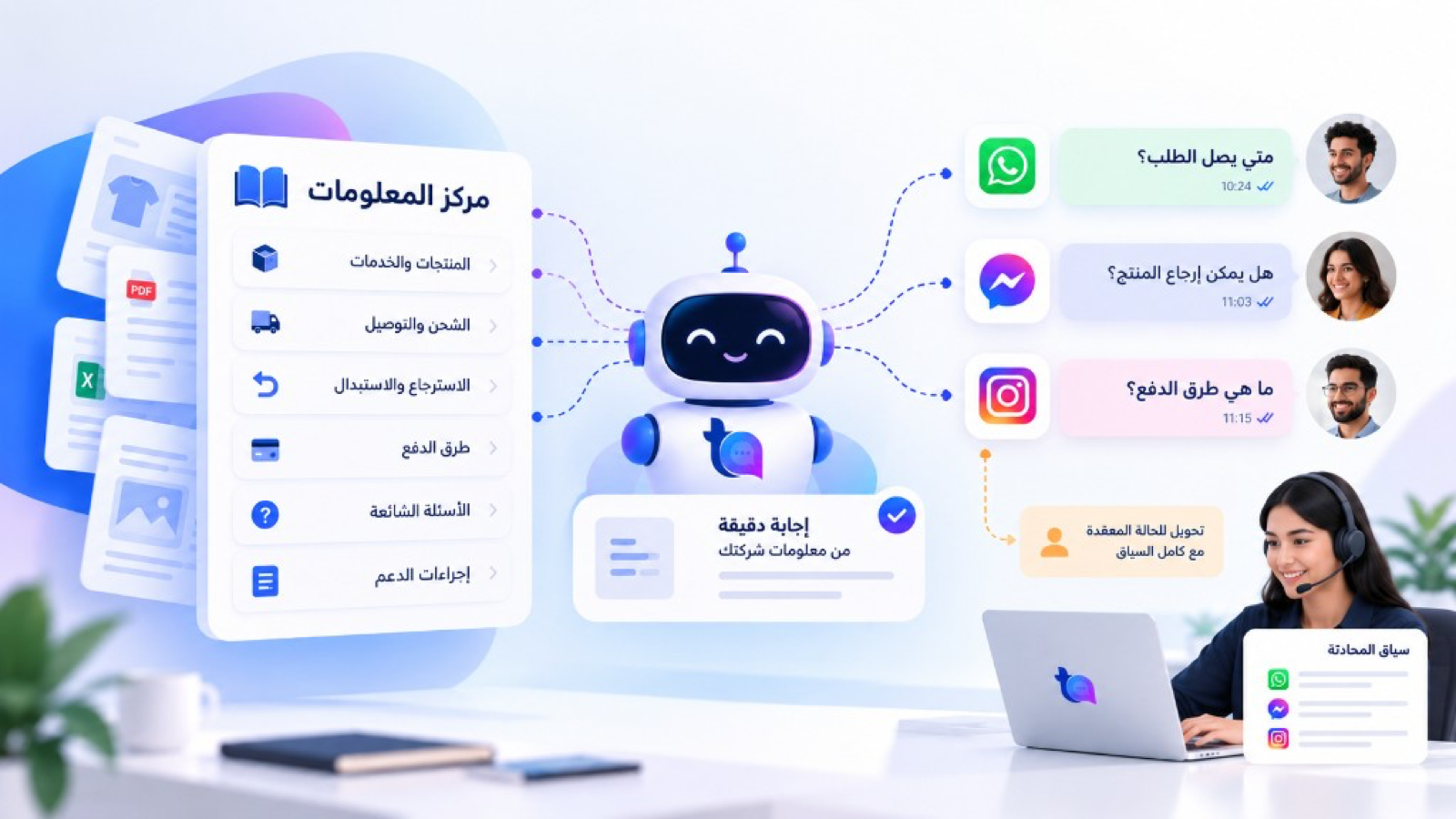
Imagine a customer messaging your business on WhatsApp at 11 PM:
"If I order today, when will my package arrive? And can I return it if the size doesn't fit?"
You already have Tawasol available around the clock. Great.
But does Tawasol actually know your delivery times? Does it understand your return policy? Or does it only have vague information like "We deliver nationwide" and "Returns are available"?
The difference between a helpful Tawasol reply and a generic one often comes down to the quality of the information behind it.
That's where a well-organized Knowledge Center comes in.
The Knowledge Center gives Tawasol and your customer support team access to accurate, consistent, and up-to-date business information, helping them answer questions faster and resolve customer issues more efficiently.
In this guide, we'll explain what the Knowledge Center is, why it matters for Tawasol, how to structure it, and how it can improve both Tawasol replies and human customer support.
What Is the Knowledge Center?
The Knowledge Center is a centralized collection of information that Tawasol can use to answer customer questions about your business.
Instead of keeping important information scattered across PDF documents, spreadsheets, old WhatsApp conversations, internal messages, and employees' personal knowledge, you organize everything into one reliable source.
It typically includes:
- Product descriptions, specifications, and pricing.
- Shipping and delivery policies.
- Return, refund, and exchange procedures.
- Payment methods and billing information.
- Business hours and booking availability.
- Frequently asked questions (FAQs).
- Troubleshooting instructions.
- Guidelines for situations requiring human assistance.
For example, an e-commerce business might organize its knowledge into separate sections for shipping, returns, payments, and product information.
Each section provides clear answers to specific questions customers frequently ask.
The Knowledge Center isn't just a place to store information. It's the foundation Tawasol and your team use to deliver consistent, reliable customer support.
Why Is the Knowledge Center Important for Tawasol?
Tawasol can understand customer questions written in different languages, conversational styles, and even messages containing spelling mistakes.
However, understanding a question is not the same as knowing the correct answer.
Tawasol might understand that a customer is asking about returns, but it still needs access to your actual return policy.
Without that information, it may provide an incomplete response, ask the customer to contact support unnecessarily, or generate an answer that doesn't match your business rules.
Let's look at a practical example.
Before: Incomplete business information
Your Knowledge Center contains:
"Delivery is available nationwide. Returns are accepted."
Customer: "How long does delivery take to Alexandria?"
Tawasol doesn't have enough information to provide a specific delivery estimate.
Any delivery time it invents would be an unsupported guess.
After: Clear, structured information
Your Knowledge Center contains:
"Delivery to Alexandria takes 2–3 business days. Shipping costs EGP 60. Orders above EGP 1,000 qualify for free shipping."
Customer: "How long does delivery take to Alexandria?"
Tawasol: "Delivery to Alexandria usually takes 2–3 business days. Shipping costs EGP 60, but it's free for orders above EGP 1,000."
These figures are illustrative examples, not actual shipping policies.
The second response is more useful because Tawasol has access to specific, relevant information.
Better knowledge leads to better-informed replies from Tawasol.
Of course, the Knowledge Center alone doesn't guarantee perfect accuracy. Tawasol also needs reliable information retrieval, clear response rules, and appropriate handling of missing or conflicting information.
5 Ways the Knowledge Center Helps Your Support Team Resolve More Issues
The benefits of the Knowledge Center go beyond Tawasol replies.
A centralized source of information can improve how your entire customer support team operates.
1. Spend less time searching for answers
Imagine a support agent trying to confirm whether a customer qualifies for a refund.
Without organized documentation, they might need to search old conversations, open multiple files, or ask another team member.
With the Knowledge Center, the relevant policy is easier to find.
This reduces time spent searching and allows agents to focus on actually solving customer problems.
2. Deliver consistent answers across your team
Consider two customers asking the same question.
One contacts your business through WhatsApp, while another sends a message on Facebook Messenger.
If different agents rely on different information, the customers might receive contradictory answers.
The Knowledge Center helps both human agents and Tawasol reference the same approved business information.
This improves consistency across communication channels.
3. Handle repetitive customer questions
Many businesses receive similar questions every day:
- How much does shipping cost?
- What are your opening hours?
- Can I change my order?
- Which payment methods do you accept?
- Where are your branches located?
- How can I request a refund?
When these answers are documented clearly, Tawasol can handle suitable requests.
This allows human agents to spend more time on complicated cases that require judgment, investigation, or special attention.
4. Make onboarding new support agents easier
New employees don't need to memorize every product detail or company policy immediately.
The Knowledge Center gives them a reliable reference while they learn.
It can reduce repeated questions to experienced colleagues and help new team members become productive faster.
5. Improve handoffs between Tawasol and human agents
Not every customer issue should be resolved by Tawasol alone.
Some situations require access to account-specific information, special approval, or human judgment.
For example, a customer might request an exception to your standard refund policy.
Instead of making promises it cannot verify, Tawasol should recognize when human intervention is necessary.
When the conversation is transferred with its relevant context, the human agent can continue from where Tawasol stopped rather than asking the customer to explain everything again.
Useful automation isn't about removing your team. It's about helping them focus on the situations where they're needed most.
How to Structure the Knowledge Center for More Accurate Tawasol Answers
Having more information doesn't automatically mean having a better Knowledge Center.
What matters is how clearly that information is organized, written, maintained, and retrieved.
Here are six practical ways to improve it.
1. Organize content around specific customer questions
Avoid creating one massive document called "Everything About Our Business."
Instead, divide your content into focused topics such as:
- What are the shipping costs for each region?
- How can customers request a refund?
- Which payment methods are supported?
- How can customers book an appointment?
- When should a conversation be transferred to a human agent?
Smaller, clearly structured sections are easier for employees to navigate.
They also help Tawasol locate the most relevant information for a particular customer question.
2. Write complete answers, not vague statements
Compare these two examples.
Vague answer:
"Returns are accepted within 14 days."
Clear answer:
"Customers can request a return within 14 days of receiving their order, provided the product is unused and in its original condition. To start a return, contact customer support and provide your order number."
The second answer explains:
- The return period.
- The eligibility conditions.
- The action the customer needs to take.
This gives both Tawasol and the support agent enough information to provide a useful response.
Always ensure the documented conditions reflect your actual business policies.
3. Be specific whenever possible
Statements like "Fast delivery" or "Customer support is always available" sound reassuring, but they don't provide much practical information.
Instead, document:
- Delivery estimates by region.
- Exact support operating hours.
- Differences between Tawasol replies and team availability.
- Additional fees and exceptions.
- Refund eligibility requirements.
- Limitations or exclusions.
Specific information reduces ambiguity and helps prevent unsupported assumptions.
4. Remove conflicting or outdated information
Imagine one document says customers have 14 days to request a return, while another says 30 days.
Which policy should Tawasol follow?
Conflicting information makes it harder for both humans and Tawasol to identify the correct answer.
A better approach is to maintain one authoritative source for each policy and review older or duplicate content.
When a policy changes, update the relevant information consistently.
5. Use the language your customers actually speak
Your customers don't always use formal terminology.
Instead of asking, "What is your product exchange policy?", they might simply write:
"Can I change the size?"
"How much is delivery?"
"Can I update my address?"
Your Knowledge Center should account for these natural variations.
You can include common customer questions alongside clear, structured answers.
For businesses serving multiple markets, it's also useful to consider different languages and regional expressions.
The goal is to make information easy to understand without sacrificing accuracy.
6. Keep your Knowledge Center up to date
The Knowledge Center is not something you create once and forget.
Prices change. Shipping conditions evolve. New products launch. Business policies get updated.
If Tawasol relies on outdated information, it may provide answers that are no longer correct.
Assign responsibility for maintaining your Knowledge Center and review high-impact information regularly, especially pricing, availability, delivery conditions, and return policies.
Practical Example: Building the Knowledge Center for an Online Store
Let's say you operate an online clothing store.
You can start with five main knowledge categories.
| Category | Information to include |
|---|---|
| Products | Sizes, colors, materials, prices |
| Shipping | Delivery regions, estimated times, fees |
| Returns | Eligibility, deadlines, return procedures |
| Payments | Accepted methods, cash on delivery, installments |
| Support | Working hours, contact options, special cases |
Next, review your actual customer conversations to identify frequently asked questions.
For example:
Question: Can I exchange an item for a different size?
Knowledge Center answer:
"Customers can request a size exchange within 14 days of receiving their order, provided the item is unused and in its original condition. To request an exchange, contact customer support with your order number. Availability of the replacement size will be confirmed when the request is processed."
This is an illustrative policy.
Notice how the answer explains the conditions, the next step, and the fact that replacement availability must be confirmed.
That's significantly more useful than simply saying, "Exchanges are available."
What Happens When Tawasol Doesn't Know the Answer?
This is one of the most important parts of customer support on Tawasol.
Tawasol shouldn't try to answer every question at any cost. It should also recognize when the available information isn't enough.
Consider this situation:
Customer: "I purchased this item 20 days ago. Can you make an exception and accept my return?"
Your documented return policy allows returns within 14 days.
Tawasol can explain the standard policy, but it shouldn't promise an exception that hasn't been approved.
If exceptions require a manager's decision, Tawasol should direct the case to the appropriate human team.
The same principle applies when information is missing or unclear.
Rather than inventing a policy, Tawasol should acknowledge the limitation, request relevant clarification when appropriate, or escalate the issue.
This distinction is essential.
The objective isn't simply to reduce the number of conversations handled by humans.
The objective is to resolve customer issues correctly and efficiently.
How Tawasol Uses Your Business Knowledge in Customer Support
With Tawasol, the goal is to make Tawasol a knowledgeable support teammate rather than a chatbot that relies on generic responses.
Your business information becomes the foundation for answering customer questions.
Through the Knowledge Center, you can organize information such as:
- Business policies and procedures.
- Product and service information.
- Frequently asked questions.
- Shipping, payment, and return details.
- Important support instructions.
Tawasol uses that knowledge in conversations on WhatsApp, Facebook Messenger, and website chat.
When a customer asks a question, Tawasol can use relevant business information to prepare an appropriate response.
When additional details are needed, it can ask clarifying questions.
And when a case requires human judgment, it can hand the conversation over to the support team with the relevant context.
This approach combines fast replies from Tawasol with human oversight for situations that need it.
Instead of treating Tawasol and your team as separate systems, they work from the same information.
How to Know When Your Knowledge Center Needs Improvement
You don't need a complicated audit to identify the first signs of a weak Knowledge Center.
Look for patterns such as:
- Customers repeatedly asking the same question because previous answers were unclear.
- Different agents providing inconsistent information.
- Tawasol giving generic responses despite relevant business documentation existing.
- Support agents searching old messages to confirm company policies.
- Simple questions being escalated unnecessarily.
- Customers needing to repeat information after a handoff.
These issues may indicate that information is missing, outdated, difficult to retrieve, or poorly structured.
Before assuming Tawasol is the problem, review the quality of the information available to it.
A 7-Day Plan to Improve Your Customer Support Knowledge Center
You don't need to rebuild all your business documentation at once.
Start with the questions that matter most to your customers.
Day 1: Identify common questions
Review recent customer conversations and collect the 20 most frequently asked questions.
Day 2: Audit your existing answers
Identify missing details, conflicting policies, outdated information, and unclear instructions.
Days 3–4: Organize and improve content
Create focused knowledge articles with clear answers, eligibility conditions, exceptions, and next steps.
Day 5: Test Tawasol
Ask questions using the same wording your customers typically use.
Check whether the responses are accurate, complete, and supported by your Knowledge Center.
Day 6: Test difficult scenarios
Try questions involving missing information, unusual requests, policy exceptions, and situations requiring human intervention.
Make sure Tawasol doesn't invent unsupported promises.
Day 7: Establish a review process
Assign responsibility for keeping information updated and tracking questions that Tawasol cannot resolve.
Afterward, measure improvements using metrics such as:
- Answer accuracy.
- First-contact resolution rate.
- Average resolution time.
- Percentage of issues resolved without human intervention.
- Reopened conversations.
- Customer satisfaction.
Remember that a high volume of automatic replies doesn't necessarily mean better customer support.
The most important measure is how many customer problems are actually resolved correctly.
Frequently Asked Questions About the Tawasol Knowledge Center
What is the difference between a traditional knowledge base and the Knowledge Center?
A traditional knowledge base is primarily designed for people to browse and search.
The Knowledge Center gives Tawasol information it can use when answering customer questions.
The same well-structured content can support both your team and Tawasol.
How does the Knowledge Center help Tawasol avoid unsupported answers?
The Knowledge Center gives Tawasol access to verified business information instead of forcing it to rely on general knowledge or assumptions.
When combined with clear response rules, this can reduce unsupported answers.
The Knowledge Center alone cannot remove every mistake.
Can Tawasol answer customer questions from documents you add?
You can add business documents, including PDFs, to the Knowledge Center.
Results still depend on how clear the document is. Structured text is easier for Tawasol to use than a poorly formatted or scanned file.
How often should a customer support Knowledge Center be updated?
Update important information whenever business policies, prices, services, or procedures change.
It's also useful to schedule regular reviews and use unresolved customer questions to identify missing content.
Can the Knowledge Center help human agents too?
Absolutely.
The Knowledge Center helps human agents find approved information, provide consistent answers, onboard faster, and reduce time spent searching across different systems.
Conclusion: Better Tawasol Replies Start With Better Business Knowledge
Tawasol can help your customer support team respond faster, handle repetitive questions, and serve customers on WhatsApp, Messenger, and website chat.
But the quality of those replies depends heavily on the information Tawasol can access.
A well-organized Knowledge Center helps you improve accuracy, reduce inconsistent answers, support new employees, and give your team more time to focus on complex customer issues.
Start with your most common customer questions.
Document clear, accurate answers.
Keep your information updated.
And make sure Tawasol knows when to answer, when to ask for clarification, and when to involve a human.
Ready to make your business knowledge work harder?
Explore Tawasol and see how Tawasol can answer customer questions from your own information, while keeping your team in control.